


History of Conservation Districts Part One: Eighty Years of Conservation in Cheshire County!
With the end of 2025, we would like to commemorate 80 years of hard work, dedication, and pride at the Cheshire County Conservation District. The conservation work in our region wouldn’t be possible without 80 years of longstanding support from our partners and community members. As 2026 begins, other Conservation Districts across New Hampshire celebrate their 80th year. We would like to take the opportunity to share a brief history of our founding to where we are now, as well as the history of Conservation Districts as a whole. This blog will be a two-part series.
Early History in the 20th Century
The foundation of conservation districts was a result of President Franklin Delano Roosevelt’s Soil Conservation and Domestic Allotment Act in response to the devastation of the Dust Bowl throughout the 1930s and other natural disasters resulting from the effects of intense drought, clear-cutting, and biodiversity loss. He made the recommendation for every state to sign the Standard State Soil Conservation Districts Act, a step-by-step guide to create conservation districts in the country. The purpose of conservation districts was to serve as a governing entity over watershed districts that focused on local expertise to acquire federal technical assistance. Each district would be governed by a locally elected board of stakeholders (farmers, conservationists, landowners, etc.). This allowed those working directly with the land to maintain a voice in the conservation conversation. Hugh Hammond Bennett, the leader of the soil conservationist movement, said, “One of the best, and certainly the most promising, of the devices yet invented by man for dealing democratically and effectively with maladjustment in land use, as well as for carrying forward positive programs of desirable conservation, and for maintaining the work, is the soil conservation district.” (NACD 2025)

By 1945, 48 states had passed acts enabling conservation districts. This included the Cheshire County Conservation District (CCCD), the first district to be created within the state of New Hampshire. Eighty years later, CCCD is still standing strong and continuing its mission of promoting the conservation and responsible use of our natural and agricultural resources for the people of Cheshire County by providing technical, financial, and educational assistance.
From the beginning, the Cheshire Conservation District has held a partnership with the USDA Natural Resource Conservation Service (NRCS). NRCS was developed in 1935 as a permanent federal agency to “help people, help the land”. Until 1994, NRCS was known as the Soil Conservation Service (SCS). Between 1945 and 1962, SCS worked closely with the Cheshire County Conservation District, as its service area was within the same watershed, until expanding to more rural communities in 1962. In the beginning, much of the work completed outside of the board was performed by volunteers, so the scope of projects was limited. However, the Conservation District served as a direct voice of the local stakeholders, which allowed the SCS to work off of recommendations from the Conservation District to best support conservation through technical assistance and federal funding (Squire 2025).

Promoting the conservation and responsible use of our natural and agricultural resources has been a core mission of the district since 1945, and it does not come without its own learning opportunities and transitions. As science progressed, new agricultural techniques were developed that followed conservation agriculture as new needs arose. Farms prior to the mid-20th century were mainly subsistence farms in Cheshire County. These farms were small and used the resources necessary to grow enough crops for their families to survive. To do so, they greatly reshaped the landscape, clearing plots of land for pasture and crop cultivation. This was a major shift from Native American agricultural practices in the area that focused on rotating crops and producing within the confines of the natural landscape, conserving natural resources and the natural landscape. This led to an increase in drought and flooding. As a result, the conservation needs shifted. Following the Dust Bowl, Farmers began seeking resources to sustain their farms, as the 20th century saw greater crop production for the masses, more use of natural resources, and a greater need to sustain and conserve working lands. The Cheshire County farm families worked long hours on these farms to ensure a successful harvest, but with little attention to the degradation of agricultural resources. As agriculture has changed with the times, the Conservation District has always been the voice of the community, while also standing steadfast in educating on the ever-evolving world of conservation and its benefits.

There is not much written history of what exactly the Cheshire County Conservation District was doing in the mid-20th century. However, all Conservation Districts were built on the foundation of the Soil Conservation and Domestic Allotment Act, which gave principles to which the Conservation Districts served farmers and natural resources. Within that text, the priorities were listed as conducting surveys and research on soil erosion, carrying out preventive measures, cooperating or entering into agreements with government agencies to support farmers/ranchers, and acquiring or servicing land with high conservation needs. We can imagine that early on, a great deal of the work CCCD performed was research-based, and alongside farmers, as more preventative conservation techniques were developed in the region.
Through the increase of development and urbanization, farmers in Cheshire County in the late mid to late twentieth century began shifting careers, leaving massive amounts of land in Cheshire County barren. As a result, there was an increase in private buyouts and landholdings by wealthier families and individuals. For example, Louis Cabot, who was one of the wealthiest men in New Hampshire, owned over 100,000 acres of land. None of these properties were conserved or protected, putting them at risk of development. Conservationists in the area, including The Forest Society, SCS, and The Cheshire County Conservation District, played a conscious role in starting the process to place these lands within conservation easements in the 1970s. Through education and conservation efforts, private landowners began donating land for easements (Cheshire County Historical Society).
21st Century Program History Highlights
In the early 21st century, the Cheshire County Conservation District took on new leadership with Amanda Littleton being hired as District Manager. New programs, workshops, and grant programs started to shape, and the district's engagement with the general community grew. With it grew partnerships with other organizations and new programs that expanded on the educational capacity of CCCD. Continuing with its purpose, the CCCD board has continued to support the district in its programming as a dedicated group of locally elected community members. Based on their recommendations and service, the district more intensively started focusing on expanding programming under soil, water, wildlife, and farm viability.

The Farm Equipment Rental program has been a consistent and valuable service to farmers and land stewards in the region and beyond. The program allows for expensive, efficient, and necessary equipment to be rented by local growers so they can save money in equipment acquisition, while also improving soil quality and management. Alongside the Equipment Rental Program, CCCD has hosted an annual Equipment Field Day, where members of the community and conservation stakeholders can learn about the equipment, its benefits, and how to use it.

The Source to Sea River Cleanup at Ashuelot Park in Keene, NH, is another longstanding program that CCCD has been able to facilitate through the Connecticut River Conservancy. Every year, groups of volunteers meet at the park entrance with trash bags and gloves, ready and willing to clean up trash outside and within the Ashuelot River. Thousands of pounds of trash have been removed, continuing the mission of water quality management.

Since the early 2000s, CCCD has been able to acquire funding to facilitate several grant programs that help farmers, land stewards, organizations, and community members access funding for projects outside of the federal scope to help conserve natural resources, while also increasing farm efficiency and viability.
The Monadnock Co-op Farm Fund started in 2017. The Farm Fund's mission is to support local farmers in increasing sustainable food production for wholesale markets to contribute to a thriving local farm economy. Since it started, the fund has provided over $225,066 in grants to 28 local farms!

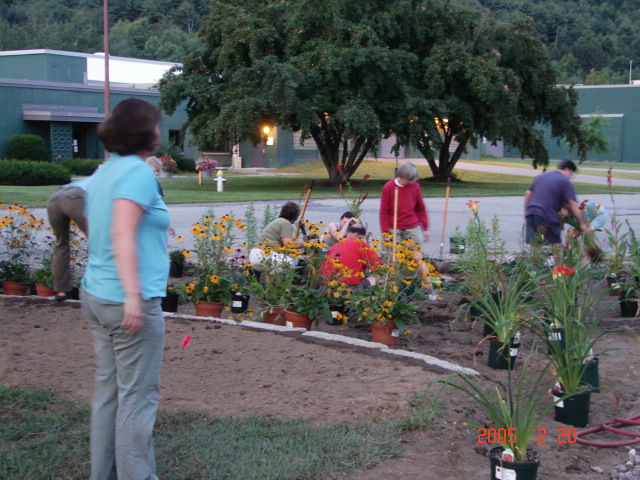
The Conservation Opportunity Fund was initiated in 2020. The purpose of this grant is to provide funding for owners or stewards of small tracts of land who are interested in improving the wildlife habitat on their property. This fund has helped community members and organizations install pollinator habitats, gardens, rain gardens, and early successional shrubland habitats. The District has also been working to build rain gardens across Cheshire County as early as 2005.
CCCD continues it’s long history of partnerships by working alongside the 10 other New Hampshire Conservation Districts to create the Climate Grant. The mission of the NH Conservation Districts Climate Resilience Grant is to support and empower local farmers to build climate resilience throughout the Granite State. This grant started in 2022 and, since then, has distributed $1,052,000 to 135 on-farm projects across New Hampshire!

Throughout the last eight decades, the Cheshire County Conservation District has evolved with the needs of our land stewards and our lands. We will continue to grow with the Monadnock Region in our mission. We love our home, and we are committed to conserving its agricultural and natural resources to sustain our planet and our community for generations to come.
We encourage you to attend an upcoming event, subscribe to our newsletter, and familiarize yourself with the many programs and services that we offer to build upon our 80 year legacy!
We are excited to continue this important work, and thank you for your continued support which enables us to conserve this special region which we call home!


Comments