


History of Conservation Districts Part Two: The Conservation District, Built on Community
In part one of this series, we discussed the history of the conservation districts and zoomed in to specifically discuss the history of the Cheshire County Conservation District in connection with that history. As noted previously, this year is a big year for New Hampshire Conservation Districts; the vast majority are celebrating 80 years since their establishment in 1946! With such a robust history, districts across the country have developed their own unique identity within a well-developed national infrastructure. The infrastructure of conservation districts is deeply embedded and dependent on community engagement and work. Yet districts and their histories have become an accidental secret not meant to be kept across the country. Understanding the history, governance process, and infrastructure of districts as a whole is crucial to understanding how important community involvement is.
Please note this is part two of a two-part series. To best understand the full scope of information, check out part one of this series.
Conservation District Infrastructure
As previously discussed in part one of this blog series, the infrastructure of all conservation districts was determined by the Standard State Soil Conservation Districts Act in the 1930’s. The first conservation district was founded on August 4th, 1937, within the Brown Creek watershed in Anson County, North Carolina. This was where Hugh Hammond Bennett, the leader of the soil conservationist movement, was born in 1881. In 1945, all 48 states had created their own districts. However, while the Act laid out the basics for systems and infrastructure, each state determined differing processes based on district division, titling, and voting. Many people think conservation districts are non-profit organizations, apart of NRCS, or a part of the county government, while they are actually a local, non-regulatory unit of government. They are considered a legal subdivision of the state government that operates with a great deal of autonomy. They are guided by a board of supervisors local to the county or watershed they represent and are typically grant-funded, similar to a nonprofit. Districts are then staffed by the Board of supervisors dependent on the conservation needs. Staffing and grants are pursued by a board appointed District Manager.

In every state, districts were divided up most commonly by county, but in some cases, a conservation district will cover an entire watershed. Depending on the state, its unique conservation needs, and the sentiment of the District Board, a conservation district may be called several different names, such as Land Conservation Departments, Natural Resource Conservation Districts, Natural Resources Districts, Resource Conservation Districts, Soil Conservation Districts, Soil & Water Conservation Districts, and Conservation Districts (NACD, nacdnet.org).
The process for voting in board members, the number of board members, and the layout of the board are different depending on the state. For example, the supervisory boards in the ten New Hampshire Conservation Districts, including CCCD, consist of land occupiers within the district. They are appointed by the State Conservation Committee as a part of the NH Department of Agriculture, Markets, and Food. The candidates for the Board of Supervisors are nominated by the district itself based on the candidates' interest, commitment, and engagement in the county's conservation needs (New Hampshire Department of Agriculture, Markets and Food, agriculture.nh.gov).
Other states, like Vermont or Massachusetts, require positions on the board to be voted in by residents within the district boundary. Some states deem eligible voters as those who own land at specified acreage, while others require voters to be land occupiers (i.e., not limited to those who own land). The supervisory board roles consist of multiple Board Supervisors, a Board Chair, a Vice-chair, and, depending on the district, a Treasurer and/or Secretary. Members of the Supervisory Board are subject to term limits.
At the Cheshire County Conservation District, we also have Associate Board Members who attend board meetings, inform decision making, and are appointed by the Board of Supervisors. Associate Board Members are eligible to become Board Supervisors when a seat becomes available within the Supervisory Board and are nominated to the State Conservation Committee for confirmation (CCCD, cheshireconservation.org). Board meetings are a great way for the community to be involved, as they are open to the public. Cheshire County Conservation District board meetings are on the 4th Thursday of every month from 9:00 am to 11:30 am at Hannah Grimes in Keene, New Hampshire.

State and National Conservation District Associations
You might be wondering who or what helped the districts create such a robust infrastructure and set of processes. In the 1940’s, it became apparent that there needed to be a state-led association that informed regional policy for district formation, addressed regional problems that existed among district boundaries, and provided a collective voice. This is the reason that districts within individual states share the same processes for board coordination and voting processes. The New Hampshire Association of Conservation Districts (NHACD) began in 1946 as a result of the formation of all ten New Hampshire Conservation Districts. The mission of NHACD is “to provide statewide coordination, representation, and leadership for Conservation Districts to conserve, protect, and promote responsible use of New Hampshire’s natural resources” (Quote from NHACD). Work at NHACD focuses on a wide range of activities, which include but are not limited to providing technical assistance and educational resources, supporting conservation initiatives, and engaging local communities and stakeholders (NHACD, nhacd.net).
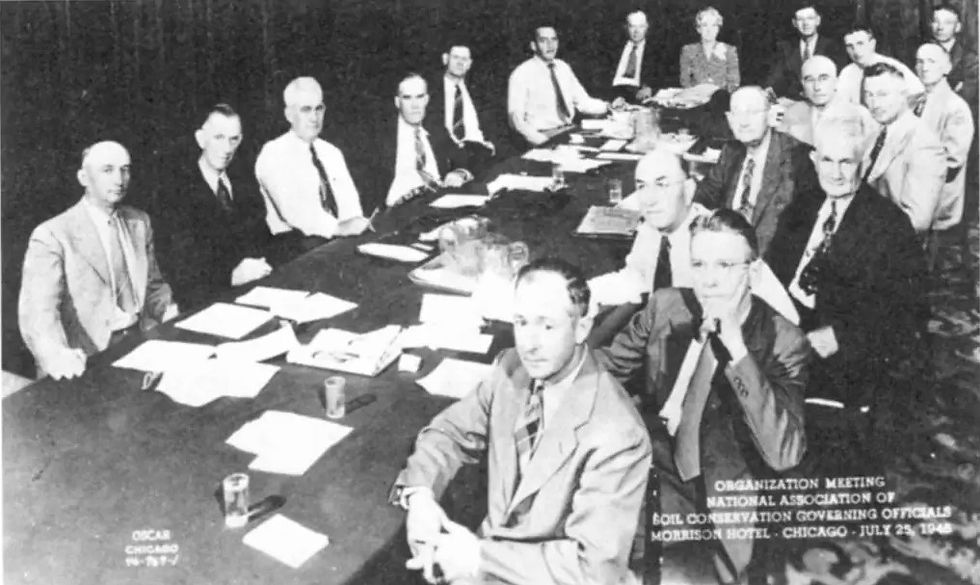
While state associations and the districts remained independent of one another, the shared mission was and has always been “to coordinate assistance from all available sources—public and private, local, state, and federal—to develop locally-driven solutions to natural resources concerns” (Quote from NACD). This meant that the districts not only needed support in development, but also a shared resource in federal advocacy. As a result, on July 25th, 1946, 18 representatives from 17 of the 48 states gathered at the Morrison Hotel in Chicago, Illinois. That meeting established the National Association of Soil Conservation District Governing Officials. This association exists as a non-profit (501c3). The first Executive Director was Ellen Cobb, an SCS (NRCS) employee in South Carolina. The first annual meeting (preceding the initial gathering) was held in February of 1947 in Chicago. At this meeting, representatives from 42 of the 48 states were in attendance. In 1970, it was decided at the Annual Meeting in San Diego to change the name of the association to the National Association of Conservation Districts (NACD). To this day, NACD represents 3,000 districts within all 50 states, the District of Columbia, and seven U.S territories. Together, there has been continued development of locally led conservation through grassroots advocacy, education, capacity development, training, and outreach NACD, nacdnet.org).
Local Working Groups and Community Voice
While infrastructure exists within districts and outside of districts within associations, the most consistent and perhaps most crucial function of it all is the community it serves. For that reason, when the Soil Conservation Service (SCS), now known as the Natural Resources Conservation Service (NRCS), was first established in 1935, along with it, Local Working Groups (LWG) were formed. As districts formed in 1945 and onwards, LWGs were typically chaired by the local conservation districts. Local Working Groups exist as a way for the community to share their voice on the prioritization of natural resource concerns by NRCS. LWGs have no enforcement authority, but they are crucial as the results from these groups are highly considered in the administration of programming. While once again, it is dependent on the state, Local Working Groups are typically held once a year and are administered by NRCS, the local conservation district, and other LWG members such as county representatives, individuals from agricultural and environmental nonprofits/agencies/organizations, and other state or local officials. The process and responsibility for a Local Working Group is based on the Locally Led Conservation Model as seen in the figure below (NRCS USDA, nrcs.usda.gov).

The Local Working Group meeting is open to the public, and serve as a open discussion among members. It is highly encouraged that community members attend these meetings to address the local working group and make their voices heard on resource concerns within their community. There will be a Local Working Group for Cheshire and Sullivan County on Monday, March 16th from 5:30pm-6:30pm. Keep an eye on the CCCD events page. If you want your voice to be heard, this is a great way to be involved in local conservation.

Much like the environment itself, the history, development, and modern workings of conservation districts and local conservation initiatives are robust, complicated, and ever-evolving. At the core of it all is community and the required engagement to best support our agricultural and natural resources as the mechanism for our shared livelihood. At the Cheshire County Conservation District, we thank every one of you for your continued support and engagement that keeps local conservation alive and well.
We encourage you to attend an upcoming event, subscribe to our newsletter, and familiarize yourself with the many programs and services that we offer to build upon our 80 year legacy!


Comments