


Listening To What We Can’t Hear: Discovering New Hampshire's Hidden Night Life
Three weeks ago, Access Conservation, the landowners, and a handful of volunteers gathered on a property in northern Cheshire County as dusk settled over the landscape. After one final gear check: Walkie-talkies? Flashlights? Water? Snacks? These adventurous naturalists carefully picked their way through the forest beneath towering hemlocks, maples, and oaks, their shadows long in the fading light. At a junction where an old logging road split, the group paused to receive their assigned monitoring locations before heading off in different directions, some toward the exposed summit of an abandoned mica mine, others to a quiet beaver impoundment ringed with hemlocks.
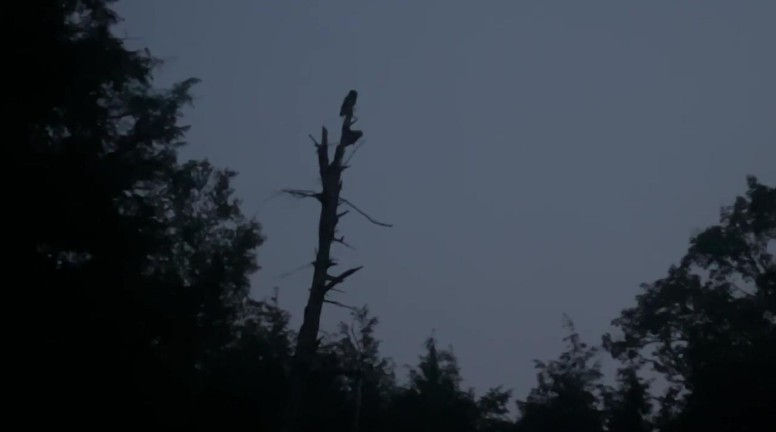
After accidentally flushing a barred owl from the mine and watching it glide silently into the dark forest, our watchers settled in as well. Leaning back with their eyes fixed on the sky, they watched the sun sink below the horizon until the humid evening, all green, blue, and purple-brown, blurred into a single dark blanket covering us as we waited.
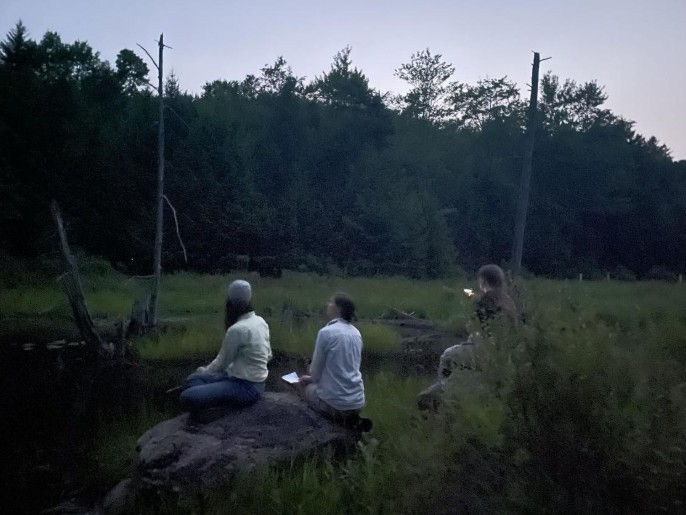
To the delight of all a walkie-talkie crackles into life: A bat! Another bat! We have bats!
Record scratch. I bet you’re wondering how we got here.
As the founder of Access Conservation, I've already spent countless hours watching wildlife footage and making educated guesses about where animals might be. Setting trail cameras and waiting for a bobcat to slip down a trail. Knowing where an otter would surface. Smiling when a black bear and her cubs
wandered into frame. Laughing when a flying squirrel appeared, showing off its impossibly awkward leaps across the forest floor. I have become pretty good at observing the natural world. But I knew there was an entire community around me that I wasn’t seeing and more than that, I couldn't even hear.
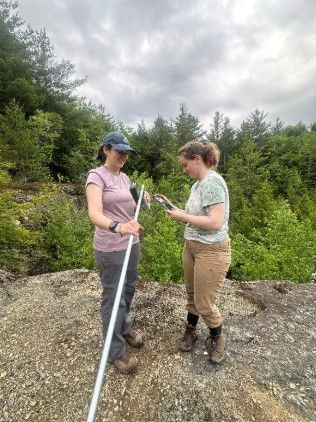
This spring, I set out to change that when we launched an acoustic bat monitoring program. It began with a client who wanted to establish a baseline of the wildlife using their property and better understand how to steward it for endangered species. In New Hampshire, our most endangered mammals are bats, and while trail cameras are incredible tools, bats present a unique challenge. They're fast, active almost entirely at night, and even when they fly past a camera, they're difficult to identify, especially before you've located a roost. If we wanted to better understand the landscape, we had to stop looking and start listening.
New Hampshire is home to eight species of bats: little brown, big brown, eastern red, hoary, silver-haired, northern long-eared, tricolored, and eastern small-footed bats. Sadly, most now face a high level of conservation concern because of white-nose syndrome, a fungal disease that devastated bat populations throughout eastern North America. Every colony, and indeed every remaining bat, matters. Due to high roost fidelity, the habitats we protect today will support generations of bats to come.
Bats often receive attention for the benefits they provide for people, and for good reason. A single bat can consume hundreds to thousands of insects in a night, helping suppress agricultural and forest pests while reducing the need for pesticides. By consuming vast numbers of insects each night, they provide a natural form of pest control while reminding us that conservation and farming often go hand in hand, a concept the Cheshire County Conservation District understands so well. But these remarkable mammals deserve appreciation for far more than what they do for us. Imagine navigating through complete darkness using echolocation or sounds beyond the range of human hearing, then interpreting returning echoes in milliseconds to avoid obstacles and catch insects in midair. It sounds like science fiction, yet every summer evening bats across New Hampshire perform this remarkable feat.

To tune in, we use these passive acoustic monitors to record ultrasonic echolocation calls throughout the night. Specialized software compares those recordings to reference libraries, allowing many calls to be identified to species while others can be assigned to groups such as Myotis. Those calls can also be displayed as spectrograms, turning sounds we cannot hear into something we can see. Watching those first spectrograms appear on the computer screen felt a lot like checking a trail camera after weeks in the field. There was that same excitement of discovering a hidden world that had been there all along.

Acoustic monitoring doesn't tell us how many bats are present. Instead, it reveals who is present and where they are active. It also reminds us that good bat habitat is about both complexity and redundancy. Bats rely on a diversity of roosting locations, from cavity trees and loose bark to old mines, rocky ledges, talus slopes, bridges, buildings, and bat houses. Healthy forests, connected wetlands, mature trees, and intact travel corridors all help support healthy bat populations.
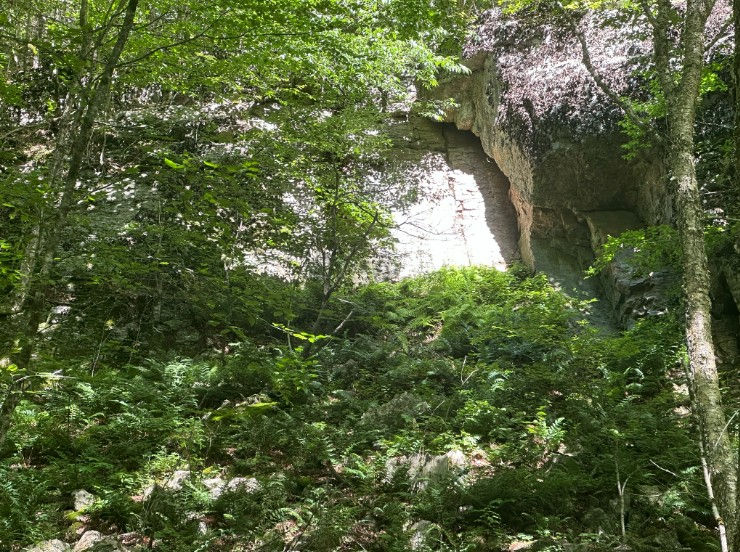
Among the sites we're monitoring in the Monadnock Region this summer is this beautiful open rock face. Its southern aspect and overgrown talus slope, rising from a northern hardwood forest, make it an especially interesting location for acoustic bat monitoring. Photo credit: Jaime McGuigan, Access Conservation.
Whether you manage a backyard woodlot, hundreds of forested acres, or agricultural lands, there are simple ways to make a difference for bats:
Assume bats are using your property, even if you rarely see them.
Set up two adjacent bat houses to provide a range of temperatures as conditions change.
Retain large cavity trees and standing dead trees.
Protect wetlands, streams, forest edges, and travel corridors.
Avoid disturbing known roosts.
Think about habitat across the landscape rather than focusing on a single feature.
If you think you may have a bat roost on your property, consider participating in New Hampshire's volunteer bat counts. Spending an evening counting bats as they emerge at a known site provides valuable information that helps biologists monitor populations over time.
Still wondering whether bats are even using your property?
Spend a warm summer evening near a wetland, stream, or woodland edge. Bring a friend. As daylight fades, watch the sky. You may only catch quick silhouettes darting overhead, but once you know they're there, it's hard to stop noticing them. Every swoop, turn, and successful hunt is guided by sounds far beyond our hearing, a reminder that nature is always telling stories, whether we’re equipped to hear them or not. Sometimes discovery starts with a trail camera. Sometimes with an ultrasonic microphone. But most often, it starts with something much simpler: curiosity.
So, step outside, look up, and keep your eyes and ears open. Even if you can’t hear the bats, you never know who... or who, who, whoooo... else might make an appearance.


Comments